
AI Governance Without Ratification Is Just Wishful Thinking
A lot of AI governance conversations are still stuck at the level of intention

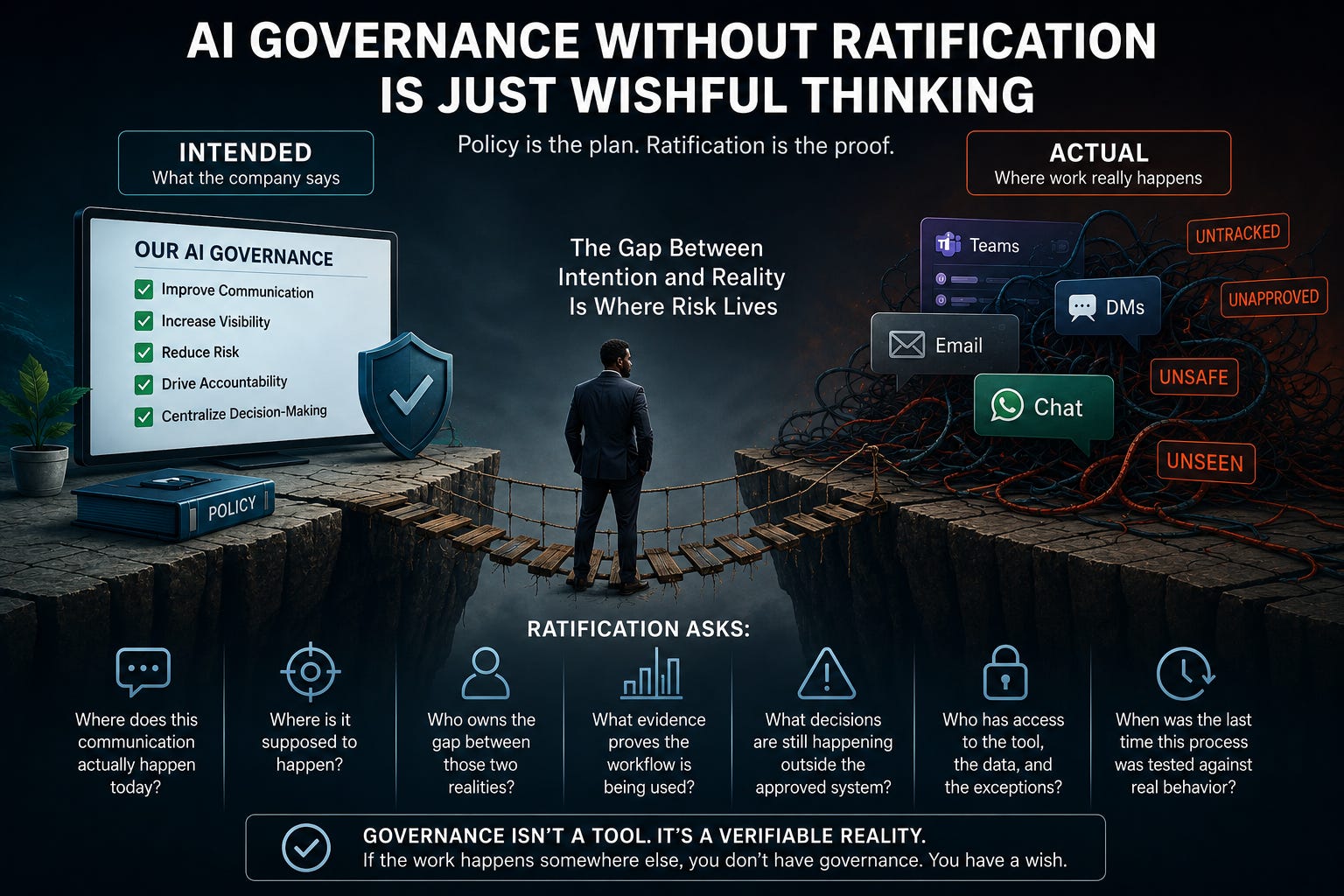
A company says a tool will improve internal communication. A vendor says their platform will centralize decision-making. A team says the new system will create transparency, accountability, and better collaboration.
Maybe it will.
But maybe the real conversations still happen in Teams. Maybe the actual approvals still happen over email. Maybe the urgent context still lives in someone’s DMs. Maybe the product of record is technically available, but the business is still operating through side channels because that is where people already know how to move.
That’s where AI governance starts to get interesting.
Not at the point where someone buys the tool. Not even at the point where someone writes the policy. The real question is whether the intended behavior has been ratified by reality.
If the system is supposed to improve communication, are people actually communicating there?
If the tool is supposed to create visibility, can leaders actually see what matters inside it?
If the workflow is supposed to reduce risk, is the risky behavior actually being redirected, or has it just moved into a less visible channel?
This is the difference between implementation and ratification.
Implementation says, “We launched it.”
Ratification asks, “Did the business actually absorb it?”
That distinction matters even more with AI because AI does not just create new outputs. It changes where decisions are made, who gets influence, what gets documented, and what can be quietly skipped.
A company can say it has an AI governance process. But if employees are pasting sensitive context into unmanaged tools because the approved process is too slow, the governance is not functioning. A company can say it has a central platform for collaboration. But if key decisions still happen in email threads and chat messages outside that platform, the source of truth is fractured.
That is not just an operations issue.
That is a cyber issue.
Access, communication, and governance are connected. If the wrong people can access the right information in the wrong place, the business has a control problem. If the right people cannot find the right information in the approved place, the business has an adoption problem. If nobody is checking the difference, the business has a ratification problem.
This’s where companies fool themselves. They confuse availability with usage. They confuse policy with practice. They confuse “we have a tool for that” with “the work actually happens there.” AI governance cannot survive on that kind of wishful thinking.
Ratification is the missing layer. It is the act of proving that the intended behavior is happening, that the right people are accountable, and that the tool or process is not just sitting there as a decorative control.
A practical ratification check might ask:
Where does this communication actually happen today?
Where is it supposed to happen?
Who owns the gap between those two realities?
What evidence proves the workflow is being used?
What decisions are still happening outside the approved system?
Who has access to the tool, the data, and the exceptions?
When was the last time this process was tested against real behavior?
Those questions are not pedantic. They are the difference between governance as a slide and governance as an operating discipline.
The future of AI governance will not be won by the company with the longest policy document or the flashiest internal platform. It will be won by the companies willing to verify whether their own claims are true.
Because if the tool says one thing, the policy says another, and the people are working somewhere else entirely, the company does not have governance.
It has a wish…